
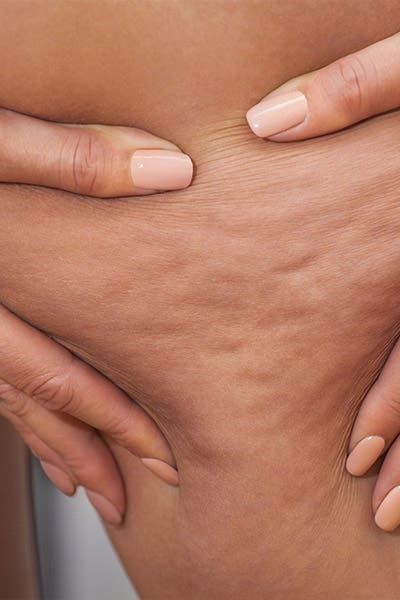
When most people hear the word cellulite, they immediately think of body fat or being overweight.
But here’s something many people don’t realise:
You can be slim, active and completely healthy and still have cellulite.
In fact, cellulite is extremely common and can affect people of many different body shapes and sizes.
So why does it happen?
What Exactly Is Cellulite?
Cellulite is the dimpled or uneven appearance of the skin that most commonly appears on areas such as the thighs, buttocks, hips and sometimes the stomach or arms.
It happens because of the way fat beneath the skin interacts with connective tissue.
Underneath your skin, connective tissue forms structures that help hold everything in place. When fat cells push against the skin while connective tissue pulls downward, it can create the familiar uneven or “orange peel” appearance.
And here’s the important part:
Cellulite isn’t simply a sign that you have too much body fat.
That’s why losing weight isn’t a guaranteed way to make cellulite disappear.
Cellulite Isn’t Just a “Weight Problem”
One of the biggest misconceptions about cellulite is that it only happens to people who are overweight.
That’s simply not the case.
A person with very little visible body fat can still have cellulite.
Why?
Because cellulite is influenced by much more than the amount of fat someone has.
Factors including genetics, hormones, skin structure, connective tissue, age and body composition can all influence how visible cellulite becomes.
So someone can be slim and still have noticeable dimpling.
And someone with a higher body weight may have relatively little visible cellulite.
Bodies are annoyingly complicated like that.
Genetics Can Play a Big Role
If cellulite seems to run in your family, you may be more likely to develop it yourself.
Genetics can influence things such as:
- How your body stores fat
- Skin structure
- Connective tissue structure
- Skin elasticity
- Circulation
- Metabolism
- Hormonal factors
This means that sometimes you can do everything “right” and still have cellulite.
It doesn’t mean you’ve failed.
It means your genetics are doing what genetics do.
Hormones May Also Influence Cellulite
Hormonal factors can influence how fat is distributed throughout the body and how connective tissue and skin behave.
This is one reason cellulite is much more common in women than men.
Changes associated with ageing and hormonal fluctuations can also affect skin elasticity and body composition, potentially making cellulite more noticeable over time.
Being Slim Doesn’t Mean Having No Body Fat
Another important point is that being thin doesn’t mean having zero body fat.
Everyone needs body fat.
Even very lean people have subcutaneous fat — the layer of fat located underneath the skin.
The appearance of cellulite depends partly on how that fat interacts with the connective tissue and skin above it, rather than simply how much fat someone has overall.
This is why you can see cellulite on someone who appears very slim.
Why Does Cellulite Become More Noticeable With Age?
As we get older, our skin naturally changes.
Collagen and elastin levels can decrease, and skin can become thinner and less elastic.
Changes in muscle mass and body composition can also affect the appearance of the skin.
As the skin becomes less firm, existing cellulite may become more visible.
So if you’ve suddenly noticed more dimpling than you did a few years ago, you’re not imagining it.
Your skin and underlying tissues naturally change as you age.
Can Exercise Prevent Cellulite?
Exercise can be beneficial for overall health and can help improve muscle tone and body composition.
Building muscle underneath an area can also influence how the skin looks.
However, exercise isn’t a guaranteed cellulite eraser.
You can be incredibly fit and still have cellulite.
Think about professional athletes, dancers and people who exercise regularly — cellulite can still be present.
Fitness and cellulite are not mutually exclusive.
Can Losing Weight Get Rid of Cellulite?
Sometimes weight loss can make cellulite less noticeable, particularly when excess body fat is contributing to its appearance.
But there’s no guarantee.
In some people, significant weight loss can actually make cellulite appear more noticeable if the skin becomes looser or loses some of its firmness.
That’s why cellulite shouldn’t be treated as simply a “fat problem.”
The appearance of cellulite can involve fat, connective tissue and skin all working together.
Can Cellulite Be Improved?
While cellulite is incredibly common and completely normal, it’s understandable that some people would prefer their skin to look smoother.
There are various approaches that may help reduce the appearance of cellulite, depending on the individual and the characteristics of their skin and body.
Body-contouring and skin-tightening treatments can form part of an aesthetic approach to improving the appearance of areas affected by cellulite.
Treatments involving technologies such as radio frequency, vacuum therapy and other body-contouring modalities may be used depending on the treatment plan and individual suitability.
The goal should be realistic:
improving the appearance of cellulite rather than promising that cellulite can be permanently erased.
You Don’t Need to Be “Thin Enough” to Have Cellulite
This is perhaps the most important message.
If you’re slim but have cellulite, there isn’t something wrong with your body.
If you’re curvier and have cellulite, there isn’t something wrong with your body either.
Cellulite isn’t a measurement of your health, your fitness or your worth.
It is a very common feature of human skin.
You don’t have to earn the right to feel confident by eliminating every dimple, line or imperfection.
But If You Want to Treat It…
There’s absolutely nothing wrong with wanting to improve something that bothers you.
Aesthetic treatments aren’t about saying that cellulite is “bad.”
They’re about giving people options when there’s something about their appearance they’d personally like to change.
At Curve-U, we can assess the area you’re concerned about and discuss which treatment options may be appropriate for your individual goals.
Because your body doesn’t have to be perfect for you to love it — but you’re also allowed to want to improve something that makes you feel less confident.